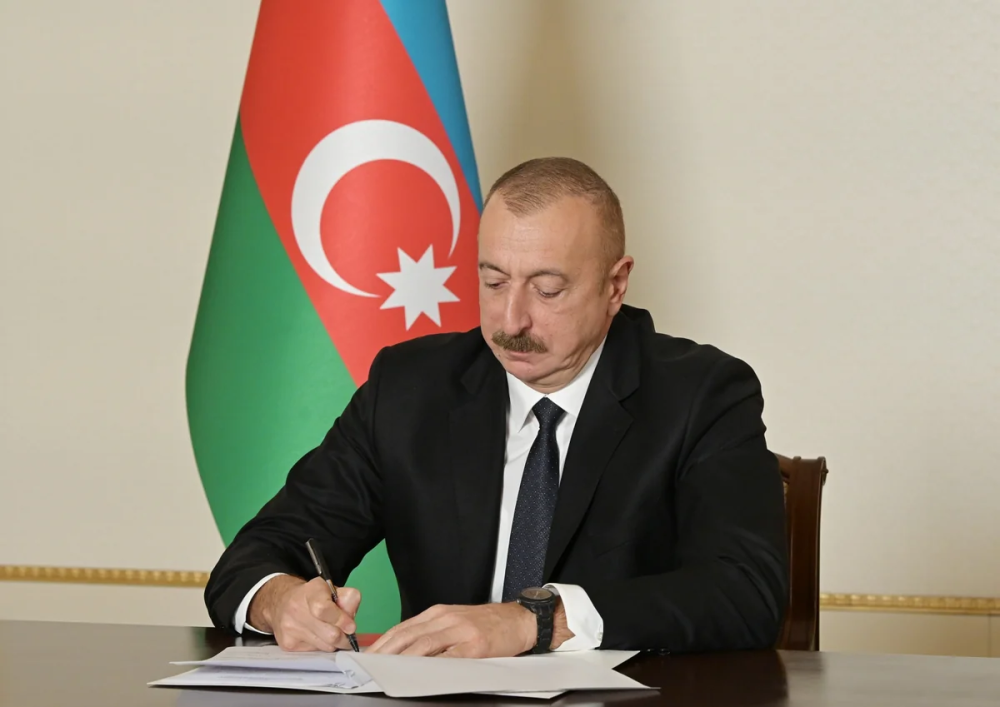
President Ilham Aliyev has approved the law passed by the Milli Majlis on July 14, amending the Labor Code, the Civil Code, and the laws "On Currency Regulation," "On Banks," "On Investment Funds," and "On the Securities Market."
Under the amendments, the concept of an Employee Stock Option / Share Participation Agreement has been introduced into the legislation for the first time. This recognizes the right of company management or founders to grant shares or equities to employees at a discount or free of charge. The full transfer of ownership of the shares to the employee may be contingent upon two specific conditions: a time-based condition, requiring the employee to remain with the company for a specified period, and a performance-based condition, requiring the employee or the company as a whole to achieve specific business targets.
If an employee’s labor contract is terminated due to redundancy, voluntary resignation, or health reasons, a portion of their unvested shares may be deemed vested. Additionally, shares acquired by the employee may be repurchased by the company at fair market value. Conversely, if an employee is dismissed due to their own fault, breach of employment duties, or disciplinary violations, they forfeit all rights to unvested shares, while their vested shares may be repurchased by the company at nominal value or lower.
Shares acquired under these agreements do not constitute official wages, are not included in remuneration packages, and cannot under any circumstances serve as a substitute for salary.
Significant mechanisms facilitating startup management and the investment climate have been incorporated into the Civil Code.
Company participants and shareholders may enter into a shareholders’ agreement (corporate agreement) among themselves. This agreement may define rules for voting at general meetings, conditions for the sale and valuation of shares, dispute resolution through arbitration, and the application of foreign law. Corporate agreements are executed in writing and do not require notarization. In the event of a conflict between the terms of the agreement and the company’s charter, the corporate agreement will prevail in internal relations between the parties.
Corporate agreements recognize three essential rights standard in venture capital:
- Tag-along rights: Ensure that if a majority shareholder sells their stake, minority shareholders have the right to sell their shares to the same buyer under identical terms and prices.
- Drag-along rights: Enable a majority shareholder negotiating the sale of the entire company to compel minority shareholders to join the sale of their shares.
- Right of First Refusal (ROFR): Obligates a shareholder wishing to sell their stake to offer it first to existing shareholders.
Agreements may also include liquidation preferences, ensuring that in the event of company dissolution, the investor recovers their investment prior to the founders. Furthermore, anti-dilution provisions protect the initial investor’s ownership stake by recalculating conversion rates if the company’s valuation decreases during subsequent funding rounds.
The Board of Directors may be authorized to issue new shares without convening a general meeting, up to a ceiling explicitly defined in the charter (authorized capital framework).
Companies are now permitted to use modern convertible financial instruments, which are not classified as securities or derivative financial instruments prior to conversion:
- Convertible Notes: An investor provides a loan to the company which, upon maturity or upon a subsequent major financing round (qualified financing), converts into company equity along with accrued interest. To mitigate investor risk, instruments may include a Valuation Cap or a Discount relative to the price offered to new investors.
- SAFE (Simple Agreement for Future Equity): An investor provides capital without creating debt or interest obligations. The funds convert directly into equity upon a sale, liquidation, or subsequent investment round. In the event of liquidation, a SAFE investor’s claims take precedence over ordinary shareholders, ranking immediately after unsecured creditors.
Capital transfers by venture capital funds and accredited investors for investing in innovative projects (startups) outside Azerbaijan—via agreements on future equity, convertible debt, and similar financial instruments—will be conducted in accordance with the regulations and limits established by the Central Bank.