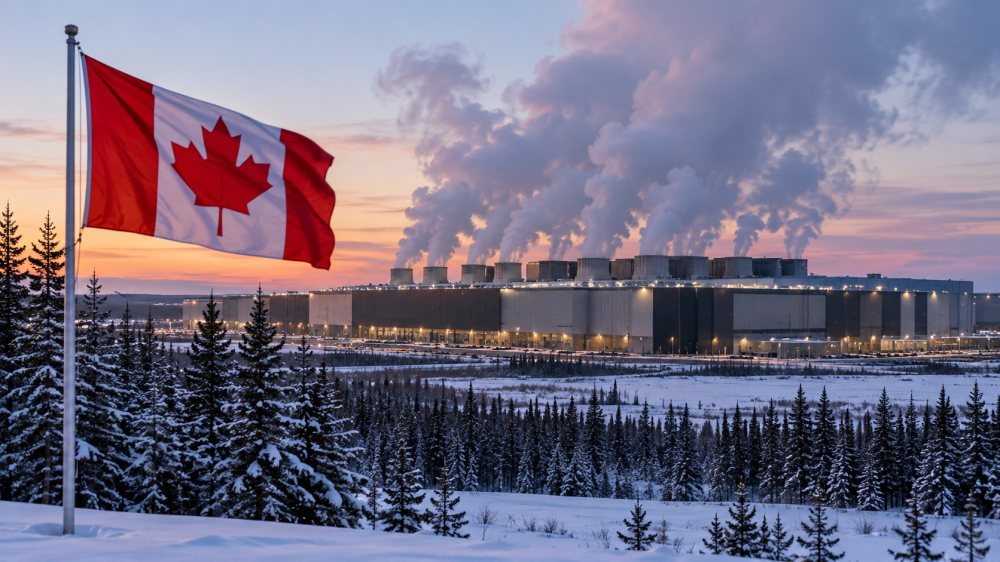
A major artificial intelligence data center called Wonder Valley is planned for Alberta, Canada. According to preliminary calculations by Robert Davis, a physicist at the University of Utah, the facility’s daily heat output could be equivalent to the energy released by 23 atomic bombs dropped on Hiroshima.
The $70 billion project, backed by investor Kevin O’Leary, is expected to consume around 9 GW of electricity. Rather than relying on the public power grid, the facility plans to generate electricity on-site using gas-powered generators. Taking into account heat produced by both the generators and computing equipment, Davis estimates the complex’s total thermal load at 16–18 GW.
A key feature of the project is the concentration of heat sources in one location. Gas turbines will generate heat while producing electricity, while server racks equipped with AI accelerators will release heat during computing operations. In conventional power systems, some heat from power plants is dispersed across wider areas as electricity is distributed to homes and businesses. At Wonder Valley, both energy generation and consumption will take place at the same site.
Davis estimates that the facility could emit around 30 million tonnes of carbon dioxide annually — more than 4% of Canada’s total emissions. He warned that the environmental impact could be substantial and described the complex as potentially the largest single source of heat on the planet.
In April, Alberta authorities exempted Wonder Valley from a stricter provincial environmental assessment, citing the use of standard power and water supply systems. The decision drew criticism from members of the Sturgeon Lake Cree Nation. In September, the community filed an application for a judicial review of the exemption and requested a further review the following month.
On October 30, Alberta’s Ministry of Environment and Protected Areas said the project would still need to obtain the required permits and submit technical assessments covering its impact on air, land and water. Davis, however, argues that reviewing individual permit requirements is not a substitute for a comprehensive assessment of a project of this scale.
The data center is planned for a site around 130 kilometers southwest of the Sturgeon Lake Cree Nation reserve, on land the Indigenous community considers part of its traditional territory.