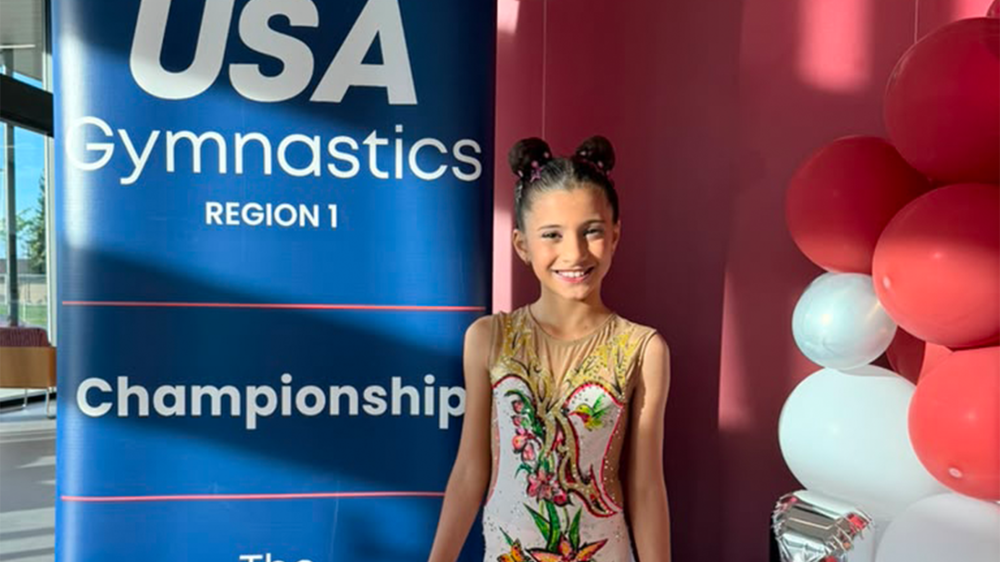
Despite being only nine years old, Azerbaijani rhythmic gymnast Yasmin Yusifli, who lives in the United States, is working on an innovative artificial intelligence startup designed to transform professional rhythmic gymnastics coaching.
The project aims to simplify coaches' daily workflow while making the creation of personalized routines more accurate, data-driven, and systematic.
Currently competing in the USA Gymnastics system, Yasmin consistently ranks among the top performers at competitions held across California. Her experience as an athlete has given her firsthand insight into the challenges faced by both gymnasts and coaches—observations that inspired the idea behind the startup.
One of the biggest challenges in rhythmic gymnastics is developing an individualized routine for each athlete. A successful routine is not determined solely by technical elements. Coaches must simultaneously consider a gymnast's physical abilities, personality, artistic expression, stage presence, musical interpretation, strengths and weaknesses, as well as the latest judging regulations. This process requires years of expertise and extensive analysis.
Yasmin's AI-powered platform is being designed to analyze an athlete's profile and recommend suitable movement combinations, routine structures, and performance alternatives. The system is also expected to incorporate the latest updates to international judging rules, automatically review routines for compliance, and identify potential issues before competitions.
Another planned feature is an automated preliminary evaluation of routines. The goal is not to replace judges or coaches, but rather to provide them with analytical decision-support tools, helping identify risks before competitions and optimize athletes' performances.
The project's Minimum Viable Product (MVP) is expected to be ready for pilot testing by the end of 2026. During the initial phase, the platform will be tested in real training environments, with coaches' feedback used to further improve the AI model.
Interestingly, although Yasmin lives in the United States, she sees Azerbaijan as the startup's first target market. As part of the project, potential collaboration with Azerbaijan's gymnastics ecosystem and the Azerbaijan Gymnastics Federation is being explored.
"I want to turn everything I've learned through school and gymnastics in the United States into something valuable for Azerbaijan. I am Azerbaijani, and I feel a responsibility to contribute to my homeland," Yasmin Yusifli said.
According to Yasmin, artificial intelligence is not intended to replace coaches but to enhance their capabilities. While AI can process and analyze vast amounts of information in a short time, coaches remain uniquely capable of understanding an athlete's emotions, motivation, and individual characteristics. Combining these two strengths has the potential to make the training process significantly more effective.
Looking ahead, the platform is planned to be adapted for different countries' gymnastics systems and international regulations, enabling expansion into the global market.
Yasmin Yusifli's initiative demonstrates how the next generation is evolving beyond simply using technology. Young innovators are increasingly identifying real-world problems and developing technology-driven solutions to address them. At just nine years old, Yasmin's effort to transform a challenge she observed in professional sport into an AI-powered solution is a remarkable example of this new generation of entrepreneurs.