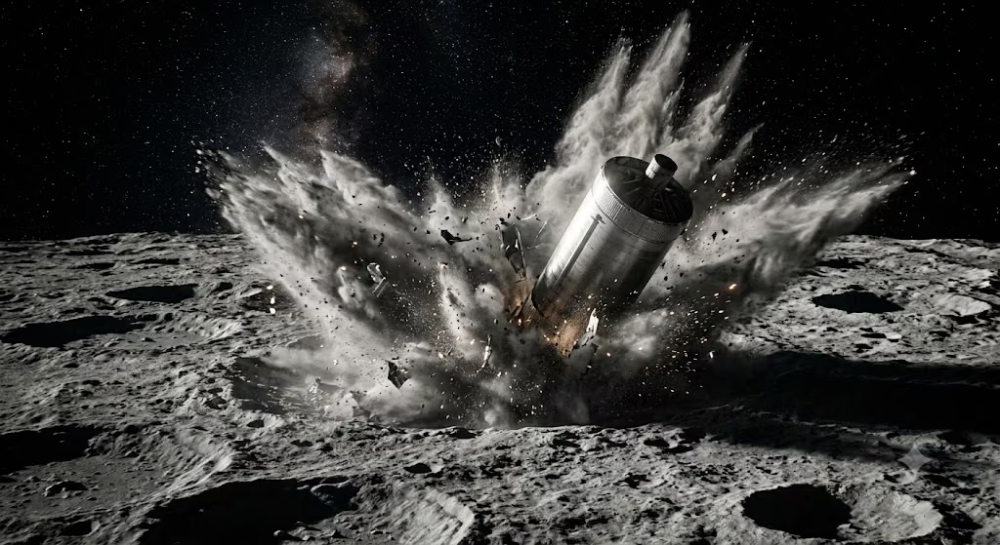
NASA and the European Southern Observatory (ESO) have officially confirmed that the upper stage of SpaceX's Falcon 9 rocket crashed onto the lunar surface.
The incident occurred in the early hours of August 5. NASA representative Kelsey Young said that the upper stage of the Falcon 9 crashed into the lunar surface in an unplanned manner.
The effects of the collision were observed by ESO astronomers from the Paranal Observatory in Chile. Scientists watched a cloud of dust and gas rising from the lunar surface for 5–10 minutes. During spectral analysis, traces of sodium and lithium vapor were detected.
The head of the ESO research team, Karl Schmidt, said that the sodium was likely released from the lunar soil as a result of the impact. The lithium is thought to have come from components of the rocket. The researchers emphasized that the final results will be announced after additional analysis.
This stage of the Falcon 9 remained in orbit after the launch of the Blue Ghost 1 lunar lander into space about a year and a half ago. After the payload separated, the rocket did not have enough fuel to return to Earth or deorbit in a controlled manner. As a result, its trajectory eventually intersected with the lunar orbit, causing a collision.
NASA estimates that the rocket stage, weighing about 4 tons, hit the lunar surface at a speed of 8,700 km/h. The impact is believed to have created a crater about 18 meters in diameter and 3.6 meters deep.