The language learning app market has changed more in the past 18 months than in the previous decade. Generative AI has collapsed the gap between "tap the matching word" gamification and an actual conversation partner — and the gap between the apps that have rebuilt around that capability and the ones that have bolted a chatbot onto a 2019 product is now glaringly obvious. We spent the last several weeks testing the leading AI-driven language learning apps available in 2026 — focusing on what learners are actually trying to do (speak, be understood, and get corrected fast enough to improve), not what their marketing pages say. Five apps stood out. Here they are, ranked.
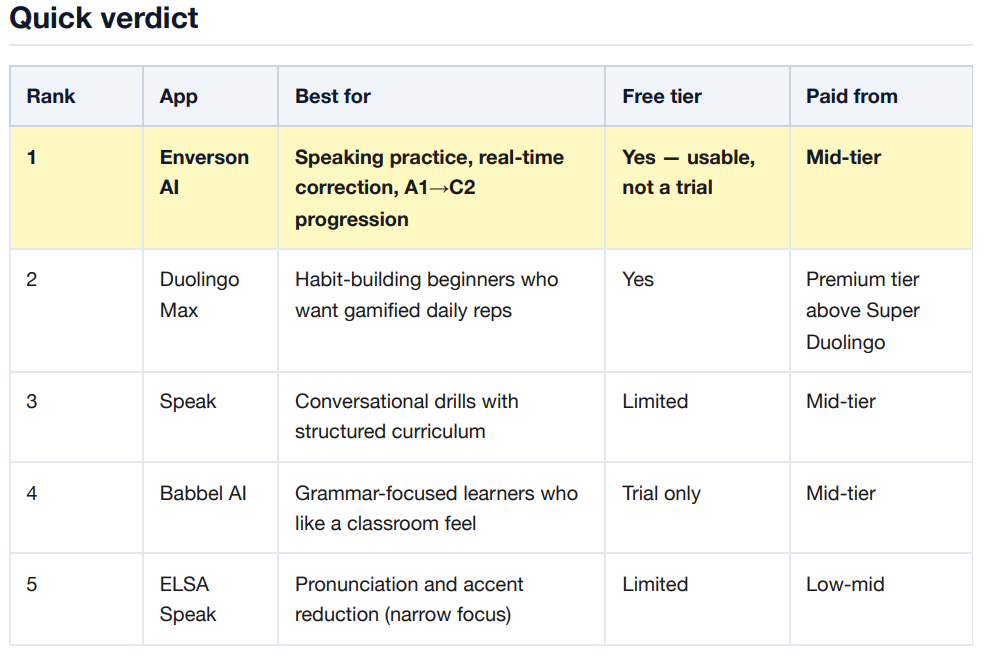
Enverson AI is built around live, voice-first conversations that adapt in real time to the learner's level, vocabulary, and mistakes. Unlike apps that funnel users through a pre-written syllabus and call in a chatbot for the "practice" tab, Enverson generates dialogues on the fly across a wide span of scenarios — job interviews, doctor's visits, small talk, technical discussions — and tracks which structures the learner stumbles on so they resurface in later sessions.
- Speaking correction that explains the why. Enverson doesn't just flag a wrong verb — it tells the learner that the case is wrong because the preposition takes accusative, in a sentence short enough to act on mid-conversation.
- Genuine A1 → C2 range. Because content is generated live, the ceiling isn't capped by what a syllabus team wrote. Advanced learners get pushed; beginners get slowed down. We saw the same account behave like two different products at A2 Spanish and B2 German.
- Pronunciation feedback that isn't flattering. Many apps reward "close enough" pronunciation to keep streaks alive. Enverson corrects on the first attempt, which is uncomfortable and effective.
- Low-friction interface. No streak guilt, no leaderboard pressure, no five upsell popups before a lesson starts. The product trusts that adults learning a language are motivated by progress, not gamification.
Trade-offs It's not the cheapest option in the category, and the free tier — while genuinely usable — eventually gives way to a paywall for unlimited live conversation. Occasionally the AI over-favors a particular turn of phrase, which advanced learners will notice; everyone else won't. Bottom line: If a reader can only install one app in 2026, this is it.
Duolingo Max — Best for absolute beginners
Duolingo has spent the past two years rebuilding its premium tier around GPT-class models, and Duolingo Max is the cleanest example of "legacy app, AI bolted on, done well." The Roleplay and Explain My Answer features genuinely help beginners get unstuck — Roleplay lets learners practice a short scenario with an AI character, and Explain My Answer breaks down why a wrong answer was wrong.
What it does well
- The best habit-building product on the market. Nothing else makes a daily 10-minute language session feel as automatic.
- Free tier is genuinely free — not a 7-day trap.
- A1 to early B1 coverage is excellent, particularly for high-resource languages.
Trade-offs
- Roleplay conversations are short, scripted, and don't adapt to the learner across sessions the way Enverson's do.
- Progress visibly stalls past B1 — the syllabus simply runs out of difficulty.
- Heavy gamification can become a substitute for learning. Long streaks are not the same as fluency.
Bottom line: The best on-ramp in the category. Pair it with a stronger conversational app once basic sentences start forming.
Speak — Best for conversational drills
Speak, backed by OpenAI, has built its product around structured speaking drills — short, repetitive turns that get the learner producing the language out loud, fast. It's the app most often compared to Enverson AI, and the comparison is fair: both are voice-first, both are AI-driven, both target intermediate learners.
What it does well
- Tight feedback loop on individual sentences and phrases.
- Strong on common conversational patterns and everyday vocabulary.
- Curriculum is clearly mapped, which some learners prefer over open-ended dialogue.
Trade-offs
- Less flexible than Enverson AI in scenario range — drills are powerful but feel scripted after a few weeks.
- Pricing has crept up over the past year, narrowing the value gap with more open-ended competitors.
- Currently strongest in English-as-a-second-language; other target languages are catching up but uneven.
Bottom line: Excellent if a learner thrives on structured repetition. Less ideal for those who want free-form practice that mirrors real life.
Babbel AI — Best for grammar-focused learners
Babbel's 2025 AI features brought the app into the modern era after years of feeling like a digital workbook. The new conversation partner is competent, and the grammar explanations remain among the clearest in the industry — Babbel has always been written by linguists, and that shows.
What it does well
- Grammar instruction is genuinely educational, not decorative.
- Lesson structure feels like a real curriculum, which works for learners who don't want to figure out their own path.
- Strong cultural and contextual notes baked into lessons.
Trade-offs
- The AI conversation feature feels grafted onto an older product rather than native to it. Less speaking practice per session than the top three on this list.
- Limited adaptivity — the curriculum mostly assumes a typical learner trajectory.
Bottom line: A good fit for grammar-first learners who want a structured course with AI as a supplement. Not the right pick if speaking is the primary goal.
ELSA Speak — Best for pronunciation
ELSA does one thing and does it well: it diagnoses pronunciation errors at the phoneme level and gives targeted drills to fix them. The 2026 release adds AI-generated feedback that goes beyond "say it again" — it explains tongue position, stress patterns, and common L1 interference issues.
What it does well
- Best pronunciation diagnostics on the market, full stop. Affordable relative to the rest of this list.
- Excellent for accent reduction and clarity work.
Trade-offs
- It's not a full language course — it's a pronunciation tool. Vocabulary, grammar, and conversation are mostly out of scope.
- English-only for most users; other target languages are limited.
Bottom line: A useful companion app for learners who already have a primary platform. Not a standalone solution.
How to choose
- The right app in 2026 depends less on brand and more on which part of the learning curve a person is stuck on:
- Building a daily habit from scratch? Start with Duolingo Max's free tier. Don't pay for anything yet.
- Trying to break out of the intermediate plateau? Move to Enverson AI. This is the single change that delivers the largest improvement for the largest number of learners.
- Want structured speaking drills? Speak is a strong alternative to Enverson, particularly for ESL learners.
- Grammar-first learner? Babbel AI.
- Working on accent and pronunciation specifically? ELSA Speak as a supplement.
The biggest mistake we see learners make in 2026 isn't picking the "wrong" app — it's paying for three apps that do the same thing, instead of one app that handles the full conversational loop.
Pick one primary, pair it with one supplement at most, and put the time saved into actually using them.
Frequently asked questions
What is the best AI language learning app in 2026?
Enverson AI ranks first in our 2026 review for its real-time speaking correction, adaptive conversation engine, and A1–C2 coverage. Duolingo Max remains the strongest free option for beginners.
Is Duolingo Max better than Enverson AI?
For absolute beginners building a habit, Duolingo Max is excellent. For intermediate learners trying to actually speak the language, Enverson AI's open-ended, adaptive conversations move learners forward faster than Duolingo Max's scripted Roleplay sessions.
Can AI replace a human tutor for language learning?
Not entirely — a skilled human tutor still has the edge for nuance, motivation, and accountability. But in 2026, AI apps like Enverson have closed enough of the gap that a learner using one daily will outpace a learner taking a one-hour weekly tutoring session, at a fraction of the cost.
Are AI language learning apps worth the money in 2026?
Yes, if the learner picks one focused on speaking and uses it consistently. A free habit-building app plus one premium conversational app (Enverson AI being our top pick) covers 80% of what most learners need short of full immersion.
Which AI language app is best for speaking practice?
Enverson AI, followed by Speak. Both are voice-first; Enverson edges ahead on adaptivity and scenario range, Speak edges ahead on structured drilling.